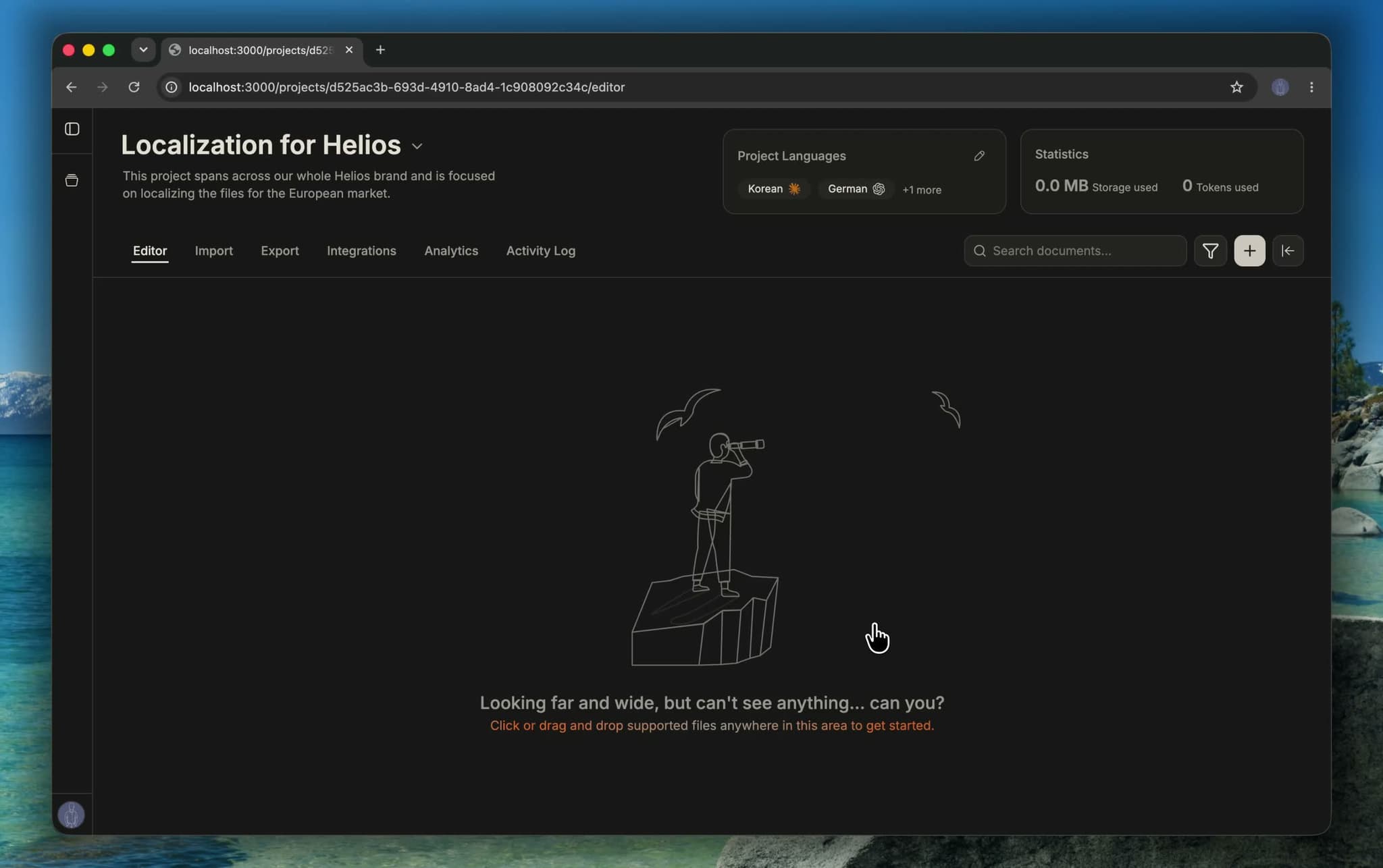
i18ner is an AI-native localization platform. Bring your own keys, skip per-string pricing, collaborate with others and take control of the whole localization workflow, from start to finish.
Upload your files
Upload your files, or connect GitHub and every push syncs new strings.
Perform translations
Your own keys, translation memory and glossary do the first pass.
Review & Refine
Translators edit side by side in real time. Reviewers approve or send it back.
Ship the translations
Download files in the shape you uploaded, or get a pull request.
A probabilistic system can give you a good-enough translation. i18ner builds a deterministic system around AI. It , holds every draft to , , lets , and hands your file back . The more your team translates, the more it knows, and nothing you have translated is paid for twice. i18ner is the deterministic layer a serious product needs on top of a translation, whether it be AI- or human-generated.
Translation memory
A translation memory is the record of everything your team has already translated and approved. It is why a professional never translates the same sentence twice, or two different ways.
Translation memory & glossary
Translation memory
Everything your team approves, kept in the project.
Pay for it once
Text you already translated in this project is never translated again, so it is never paid for again.
Say it the same way
The same sentence reads the same on every screen and in every release.
Fixes stick
When someone corrects a translation, the correction is what comes back.
Glossary
The words your product has already settled on.
Do not translate
Your product and brand names stay exactly as they are, in every language.
Always this, never that
“Workspace” is always “espacio de trabajo” in Spanish. You decide, once.
Banned terms
Words you never want in your product get flagged the moment they show up.
ChatGPT
Claude
DeepL
Google Translate
Add one key and you are ready to go. Add keys for more than one provider and you decide, for each language, which provider is tried first, second, and so on.
Everything runs on your own account, where it is billed by the providers directly. You pay us a flat fee, for the infrastructure and features: the editor, translations, review-flow, translation -memory, quality assurance and the integrations your team uses.
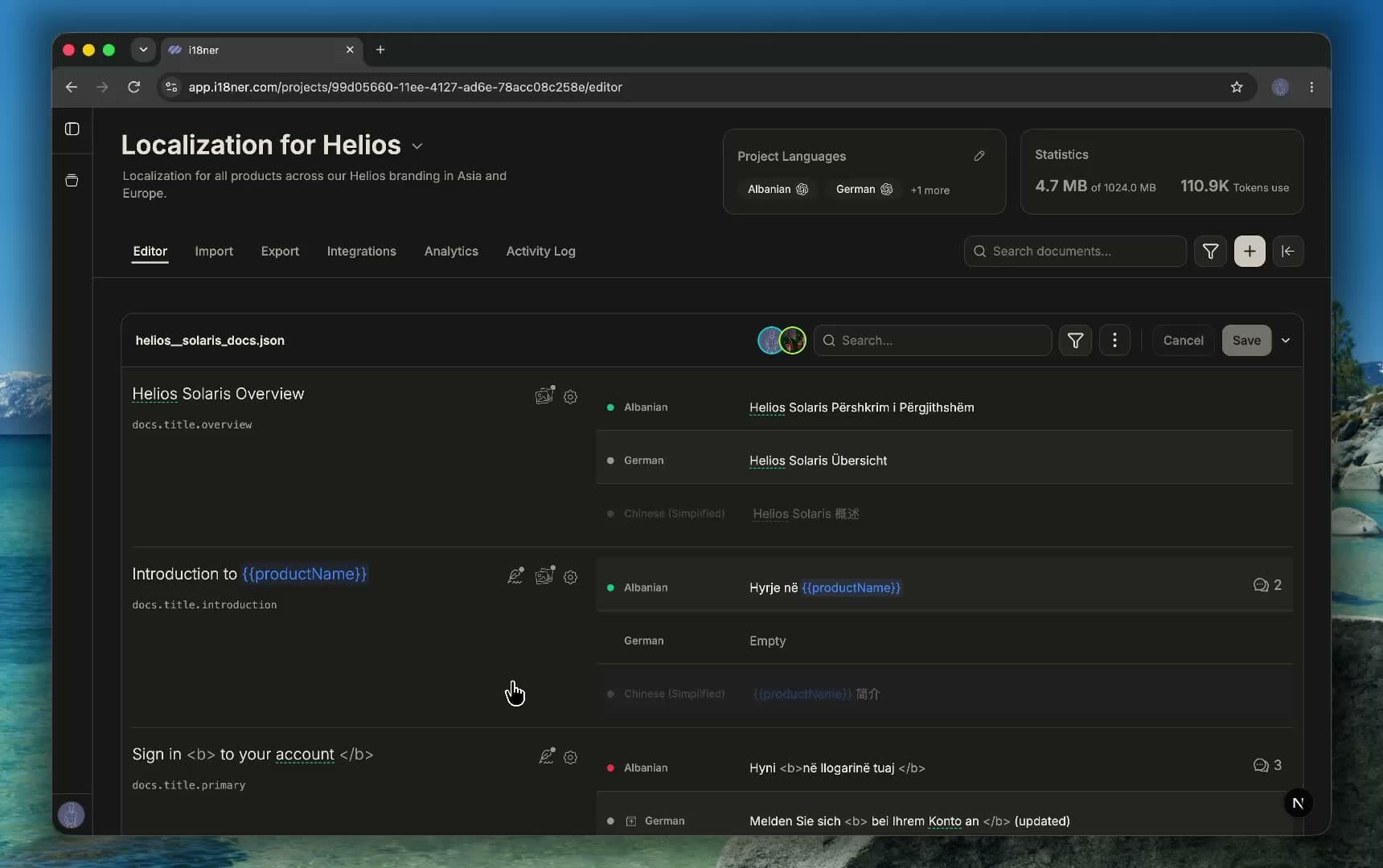
Role-based Access Control (RBAC) allows admins to bring translators and reviewers in for specific languages and have them work on those specific languages only. The other languages are not theirs to view or edit.
Every save runs the changes past checks that have been configured. A variable that went missing and would have crashed the screen, a brace left open, a term your glossary settled months ago. Each issue lands on the row it came from, and you either fix it or wave it through.
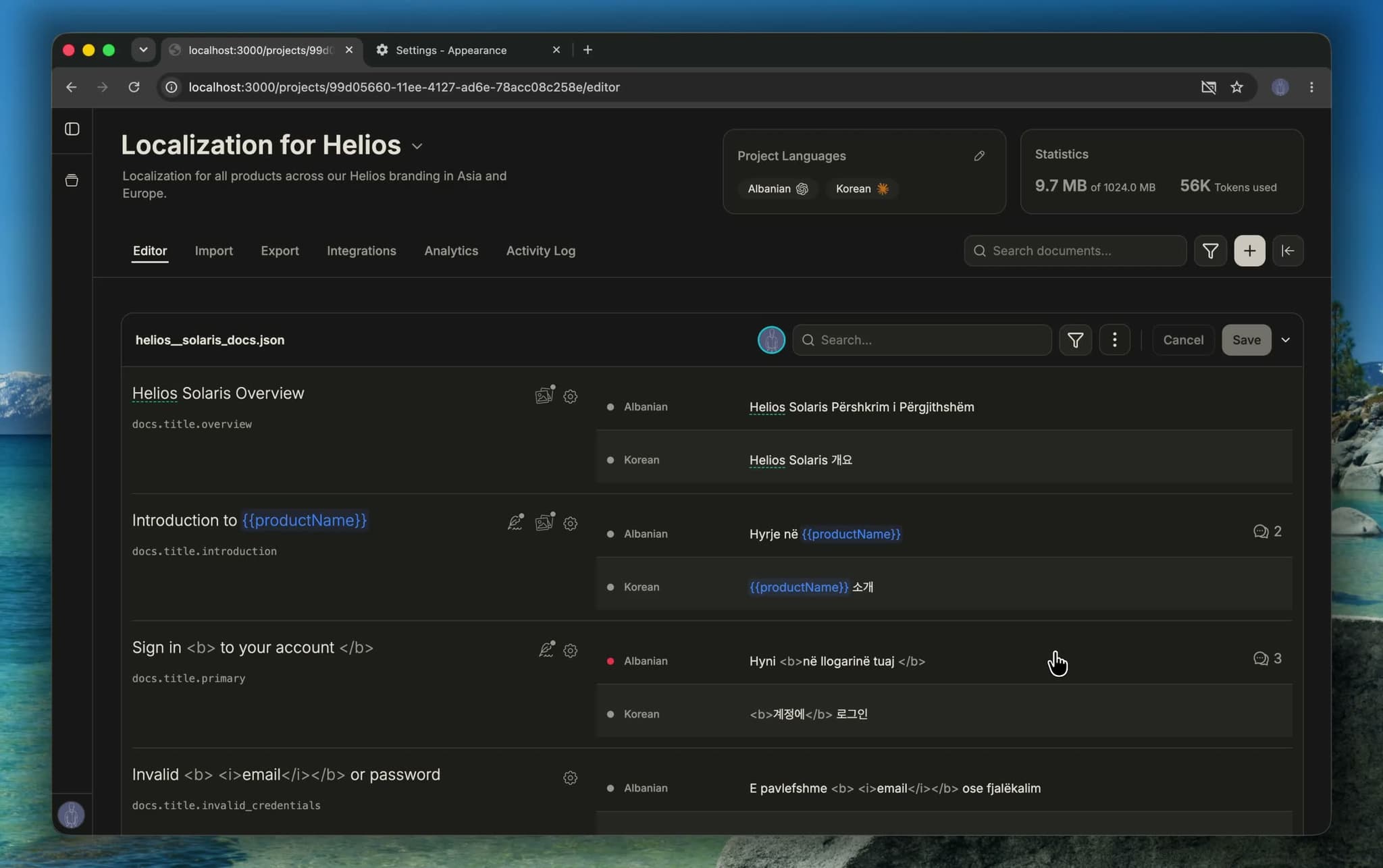
Once translations are present, reviwers can either approve it, mark it for revision, or reject it. Comments attach to every translation, so the discussions sits next to the text instead of in a thread somewhere.

Turn on the review gate and the translated files are not created until every translation has been approved. Until then there is nothing to download and no pull request to merge.
Stale translations and unresolved QA errors can hold them back the same way. Once everything clears, the files come back in the shape you uploaded, keys and structure intact.

Export your translation memory as a TMX file and your glossary as a spreadsheet, upload both, and pick up exactly where you left off.
Every translation you already paid for keeps working here, so nothing gets translated twice just because it moved. The terms your team agreed on come along too, and nobody has to settle them again.
What is i18ner?
i18ner is an AI-native translation management system for software teams. You upload the resource files your app already ships, translate them with the AI and machine-translation providers you already pay for, review the result with your team, and export the files back in the shape you uploaded them, keys and structure intact.
What file formats does i18ner support?
JSON resource files today, up to 10 MB each, and the parser list is being expanded quickly. Your translation memory and your glossary arrive separately, as a TMX file and a CSV spreadsheet, so moving off another tool never waits on the format your app happens to ship.
What does bring your own key mean?
You add your own API keys, and each provider bills your account directly for the calls i18ner makes with them. We charge a flat monthly fee for the platform and put no markup on top of anyone else's model. Add more than one key and you also get routing: for every language you decide which provider is tried first, second and so on.
Which translation providers does i18ner support?
Anthropic, OpenAI, DeepL and Google Translate, across 100+ target languages. One key is enough to start, and the keys stay yours.
How much does i18ner cost?
i18ner is a flat monthly fee: Individual at $15, Team at $100 and Scale at $300 a month, with two months off when you pay yearly. Enterprise is quoted, and adds single sign-on and limits set to whatever the work needs.
Does i18ner charge per word, per string or per seat?
No. Words translated, keys and strings, target languages and AI or machine-translation volume are not metered, subject to fair use. What a plan buys is people, projects, teams and storage. Every core feature is on every plan.
Does i18ner have a translation memory?
Yes, one per project: wording from one project never turns up in another. Every translation is ranked and stored, so when the same wording comes up again the answer comes from memory instead of another provider call. From the Team plan up, retrieval-augmented generation also puts near matches in front of the model as precedent, even when the wording is different.
Can I bring the translation memory and glossary I already have?
Yes. Export TMX from the tool you are leaving and upload it, and every segment arrives ranked and searchable, answering before a single provider call goes out. Your glossary comes along as a CSV spreadsheet, and the terms it settles are applied while translating and then checked again by QA.
What quality checks does i18ner run?
Every save runs the changed rows past the checks you turned on: a placeholder that went missing and would have crashed the screen, a brace left open, a term your glossary settled months ago. Each finding lands on the row it came from, and you either fix it or wave it through.
How do translated files get back into my repository?
Files are rebuilt into the shape you uploaded and downloaded per language, or you connect a version control system like GitHub and i18ner opens the pull request for you. Nothing ships before you say so: untranslated strings hold delivery back, and you can add gates of your own for unresolved QA errors, stale translations or anything still waiting on a review.
Can I give a translator access to one language only?
Yes. Role-based access control lets an admin bring translators and reviewers in for specific languages, and the other languages are not theirs to view or edit. Reviewers approve, mark for revision or reject, and comments attach to the translation itself rather than sitting in a thread somewhere. Collaboration starts on the Team plan.
Can I use i18ner today?
i18ner is in early access. Join the list and we will mail you launch updates and invites to the private betas.
Early access
Join the list for launch updates and private betas.